
If you have a website, getting people to find it is one of the biggest challenges of building an online presence. Simply publishing a website is not enough. Your pages need to be easy for search engines to understand and useful enough for visitors to want to read, explore, and take action.
That is where SEO (Search Engine Optimization) comes in.
SEO is the process of improving your website, content, and overall online presence so that search engines can better understand your pages and show them to people searching for relevant information, products, or services.
A well-planned SEO strategy can help you attract organic traffic, reach people with genuine search intent, build online credibility, generate leads, and create sustainable growth without relying entirely on paid advertising.
In this guide, we’ll explain what SEO is, how SEO works, why it matters, the main types of SEO, keyword research, content optimization, common SEO mistakes, and how to measure SEO performance.
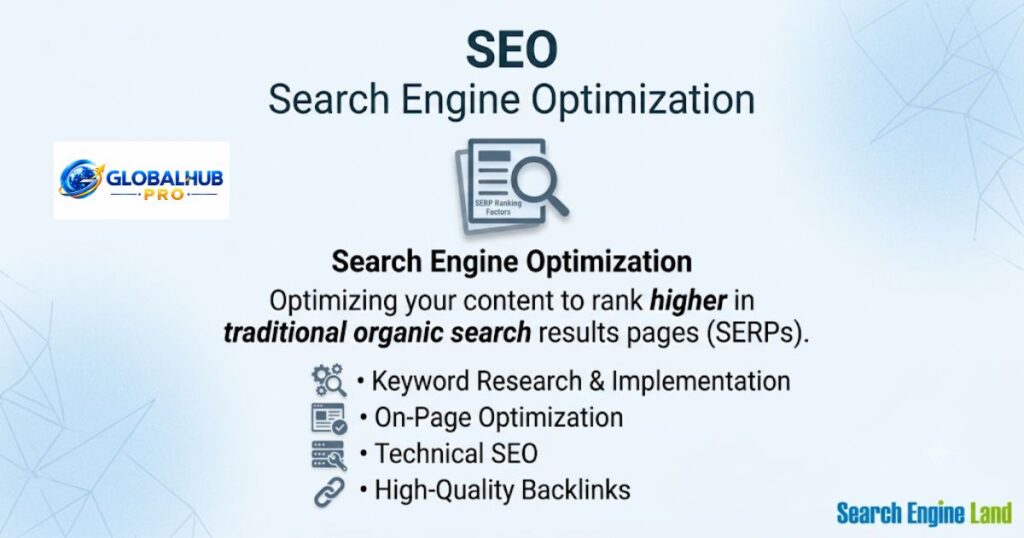
What Is SEO?
SEO stands for Search Engine Optimization.
It refers to the practice of improving a website and its content so search engines can crawl, understand, index, and rank its pages for relevant searches.
For example, imagine someone searches Google for:
“best web development services”
Google has to examine many potentially relevant pages and determine which results are most useful for that particular search.
A properly optimized website has a better opportunity to appear in relevant organic search results.
However, SEO is not simply about adding keywords to a webpage or trying to manipulate search rankings. Good SEO starts with creating a website that is genuinely useful to people while making its content and structure easier for search engines to understand.
How Does SEO Work?
Search engines such as Google use automated systems to discover, analyze, and organize webpages.
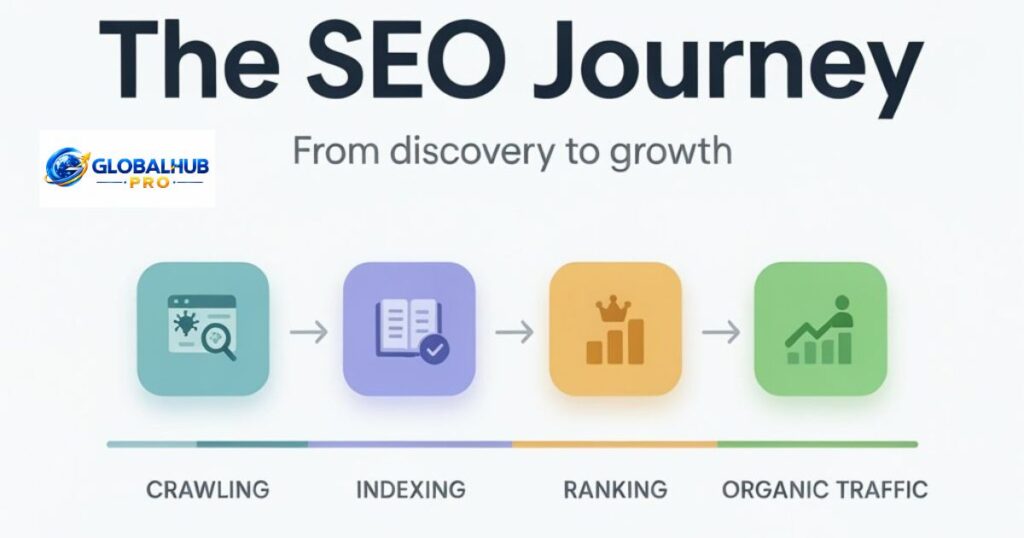
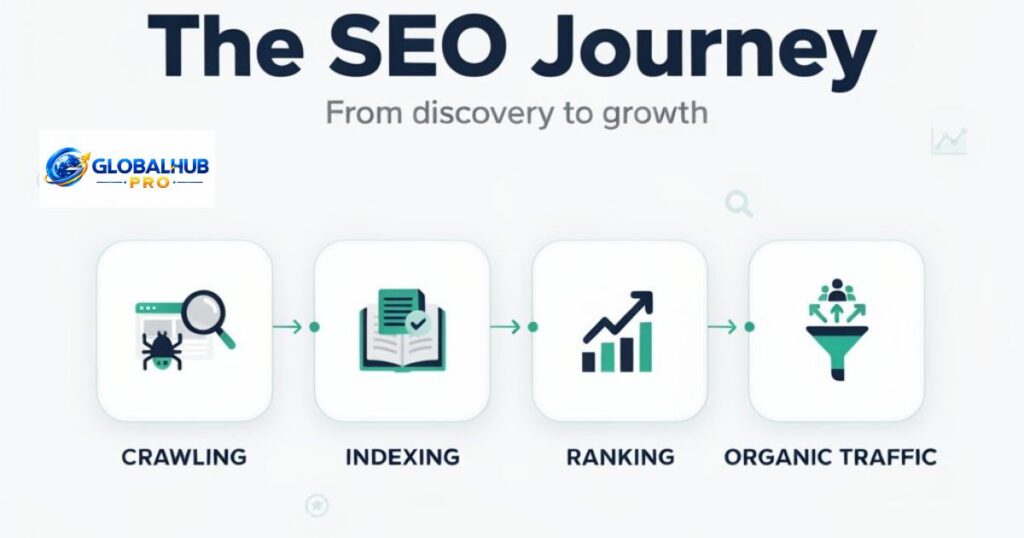
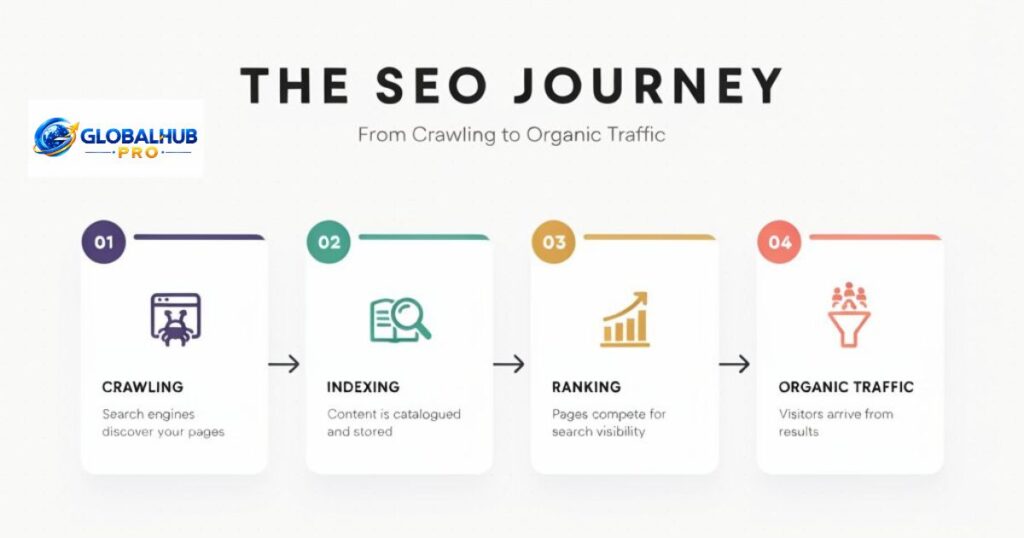
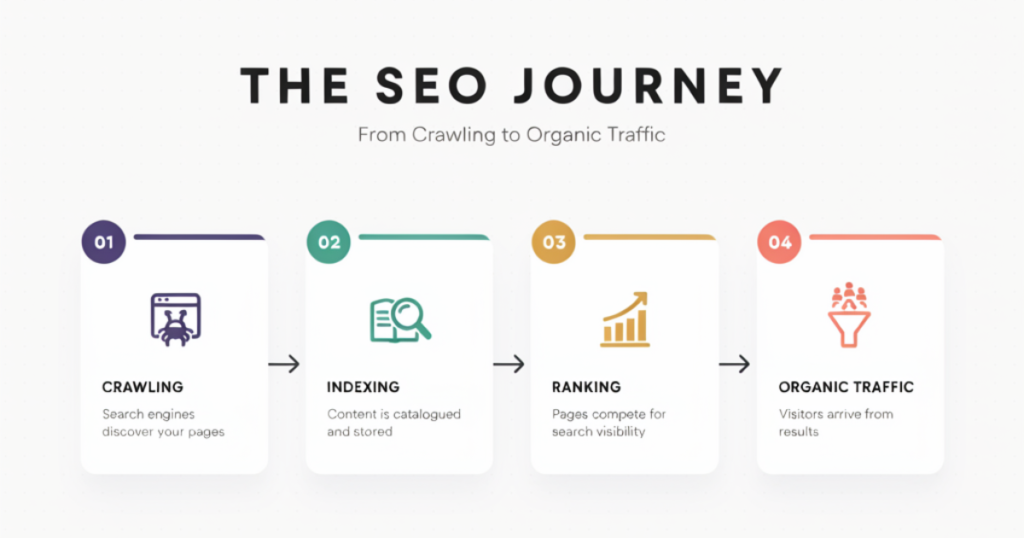
The basic SEO process can be understood through three main stages:
1. Crawling
Search engines use automated programs called crawlers or bots to discover webpages.
These crawlers follow links from one page to another, allowing search engines to find new content as well as changes made to existing pages.
If important pages cannot be crawled properly, search engines may have difficulty discovering or accessing them.
2. Indexing
After a search engine discovers a webpage, it analyzes the page and may store information about it in its index.
Think of an index as a huge database of webpages that the search engine can refer to when someone performs a search.
A page generally needs to be accessible and eligible for indexing before it can appear in organic search results.
3. Ranking
When someone searches for something, the search engine evaluates many signals to determine which pages are relevant and useful for that query.
Factors such as relevance, content quality, website structure, links, page experience, and technical accessibility can influence how a page performs in search.
That is why effective SEO involves much more than simply placing keywords throughout an article.
Why Is SEO Important for a Website?
Search engines are an important way for people to discover information, products, services, and businesses online.
A strong SEO strategy can benefit a website in several ways.
1. Increase Organic Traffic
Organic traffic refers to visitors who reach your website through unpaid search results.
When your pages appear for relevant searches, potential customers can discover your business without you having to pay for every individual click.
Over time, consistently earning relevant organic traffic can become an important part of a website’s growth strategy.
2. Reach People With Real Search Intent
One of the major advantages of SEO is that it can help you reach people who are actively searching for something related to your business.
For example, someone searching for:
“content writing services”
may already be looking for a company or professional who provides content writing.
This type of search intent can make relevant organic traffic particularly valuable for businesses.
3. Build Online Credibility
Useful and well-organized content can help a business establish credibility with its audience.
When a website consistently provides helpful information and clearly explains its products or services, visitors have more opportunities to understand what the business offers.
Strong visibility in relevant search results can also increase brand awareness.
4. Generate Leads and Customers
SEO is not just about getting more visitors.
For many businesses, the real objective is to turn relevant visitors into inquiries, leads, customers, or clients.
That means SEO should work together with clear service information, strong calls to action, simple navigation, and a positive user experience.
What Are the Main Types of SEO?
SEO covers several areas, and each one contributes to a website’s overall search performance.
The three commonly discussed areas are On-Page SEO, Technical SEO, and Off-Page SEO.
On-Page SEO
On-page SEO focuses on elements that exist directly on your website.
This can include:
- Page titles
- Headings
- Website content
- Keywords
- Meta descriptions
- Internal links
- Image optimization
- URL structure
- Content organization
The main goal is to make each page useful for visitors while clearly communicating its topic to search engines.
Why On-Page SEO Matters
Imagine that you provide an excellent service, but your webpage does not clearly explain what that service is or who it is for.
Visitors may become confused, and search engines may also have difficulty understanding the page.
A well-structured webpage makes its subject clear through a descriptive title, logical headings, useful content, relevant terminology, and appropriate internal links.
Technical SEO
Technical SEO focuses on the technical foundation of your website.
Important areas include:
- Website crawling
- Indexing
- XML sitemap
- Robots.txt
- Canonical URLs
- HTTPS
- Mobile usability
- Website speed
- Core Web Vitals
- Structured data
- Broken links
Technical SEO helps search engines access and understand your website more efficiently.
Even a well-written article may struggle to perform if important pages cannot be crawled or indexed correctly.
For this reason, technical SEO should be treated as an ongoing part of website maintenance rather than something you check only once.
Off-Page SEO
Off-page SEO refers to activities that help establish a website’s reputation and authority outside the website itself.
Link building is one of the most well-known examples.
When relevant and reputable websites link to your content, those links can provide useful signals about relationships and authority.
However, SEO is not a competition to collect as many backlinks as possible.
Quality and relevance matter more than simply increasing the number of links.
Businesses should avoid manipulative link schemes, automated links, and low-quality backlink practices.
Instead, focus on creating valuable content and building legitimate relationships that can naturally lead to relevant mentions and links.
Keyword Research: The Foundation of SEO
Keyword research is an important part of developing an effective SEO strategy.
A keyword is a word or phrase that people enter into a search engine when looking for information, products, services, or answers.
Examples include:
- SEO services
- Web development services
- Guest posting services
- Content writing services
- WordPress development
- Technical SEO services
However, choosing keywords is not simply about finding phrases with the highest search volume.
You should also consider search intent, relevance, and competition.
Search Intent
Search intent refers to what the person actually wants when they perform a search.
For example:
“What is SEO?”
is primarily an informational search.
The person wants to learn about SEO.
On the other hand:
“SEO services for small business”
suggests that the searcher may be looking for a company or professional who provides SEO services.
Understanding this difference helps you create content that matches what users are actually looking for.
Keyword Relevance
A keyword should be closely related to your business, service, or topic.
Ranking for an unrelated keyword may bring visitors to your website, but those visitors may have little interest in what you offer.
Relevant traffic is generally more valuable than traffic that simply increases your visitor count.
Keyword Competition
Some keywords are highly competitive, especially broad terms with significant search demand.
For newer or smaller websites, targeting specific and relevant search terms can be a more practical starting point than immediately competing for extremely broad keywords.
How to Optimize Content for SEO
Creating SEO-friendly content does not mean writing exclusively for search engines.
Your first priority should always be the people who will read and use your content.
Here are some practical ways to improve your content.
Create Useful and Original Content
Your content should give readers a genuine reason to visit your page.
Instead of simply rewriting information that already appears on many other websites, try to make your article more useful by:
- Explaining difficult topics clearly
- Providing practical examples
- Answering common questions
- Adding relevant insights
- Organizing information logically
The goal is to create content that satisfies the reader’s reason for searching.
Use Headings and Subheadings
Headings make longer articles easier to scan and understand.
For example:
H1: What Is SEO?
H2: Why Is SEO Important?
H2: Types of SEO
H3: On-Page SEO
H3: Technical SEO
H3: Off-Page SEO
A logical heading structure helps readers find information quickly and makes the relationship between different sections clearer.
Use Keywords Naturally
Your primary keyword can appear naturally in important areas such as the page title, main heading, introduction, and relevant sections.
You can also use related terms when they genuinely fit the topic.
Avoid repeating the same keyword simply to increase keyword frequency.
Keyword stuffing can make an article sound unnatural and reduce its readability.
Write for humans first, then make sure search engines can clearly understand the subject of the page.
Internal Linking and SEO
Internal links connect one page of your website to another page on the same website.
For example, an article about SEO could naturally link to your SEO Services page.
Similarly, an article about guest posting could link to your Guest Posting Services page.
A good internal linking strategy can help:
- Visitors discover related content
- Search engines discover important pages
- Connect related topics across your website
- Improve website navigation
- Distribute internal authority between relevant pages
As your website grows, internal linking becomes increasingly important.
Instead of adding links randomly, think about which pages are genuinely useful to someone reading the current article.
Why Does Website Speed Matter?
People expect websites to load quickly and work smoothly.
A slow or difficult-to-use website can create a poor user experience and may affect how effectively visitors interact with your content.
To improve website performance, consider:
- Compressing images
- Using modern image formats
- Removing unnecessary plugins
- Optimizing CSS and JavaScript
- Using caching
- Choosing reliable hosting
- Improving mobile performance
The objective is simple: create a website that loads efficiently and remains easy to use across different devices.
Mobile SEO
Many people access websites using smartphones, so mobile usability is an important part of maintaining a good website experience.
Make sure your website works properly on smaller screens.
Check areas such as:
- Text readability
- Button sizes
- Navigation
- Image scaling
- Page loading
- Forms
- Spacing
- Overall usability
A website that looks excellent on a desktop but is difficult to use on a smartphone can create unnecessary friction for visitors.
Common SEO Mistakes to Avoid
SEO can become unnecessarily complicated when businesses focus on shortcuts instead of building a useful website.
Here are some common mistakes to avoid.
Keyword Stuffing
Repeating the same keyword excessively can make your content difficult to read and may be treated as a spammy practice.
Use keywords naturally and focus on answering the reader’s question.
Publishing Low-Quality Content
Publishing large numbers of weak articles simply to target keywords is not a sustainable approach.
Instead, focus on creating useful, original content that genuinely satisfies search intent.
Buying Low-Quality Backlinks
Cheap backlink packages may provide links from irrelevant or low-quality websites.
Rather than focusing on the number of backlinks, prioritize relevant and trustworthy links.
Ignoring Technical SEO
A website can have excellent content and an attractive design but still experience search visibility problems if search engines cannot properly crawl or index important pages.
Technical health should therefore be part of your regular SEO process.
Forgetting About Users
SEO should never become a numbers-only exercise.
Visitors should be able to find information easily, understand your services, navigate your website comfortably, and know what to do next.
How Long Does SEO Take to Work?
SEO is a long-term strategy, and results do not usually appear overnight.
Some pages may begin receiving search impressions relatively quickly, while meaningful improvements in rankings and organic traffic can take considerably longer.
The timeline can depend on factors such as:
- Website age
- Competition
- Content quality
- Website authority
- Technical condition
- Search intent
- Backlink profile
- Consistency of SEO work
Instead of expecting instant results, monitor your website’s performance and continuously improve pages based on real search data.
How to Measure SEO Performance
Google Search Console is one of the most useful tools for monitoring a website’s search performance.
Some important metrics include:
- Impressions
- Clicks
- Click-through rate (CTR)
- Average position
- Search queries
- Indexed pages
Website analytics can provide additional information about what visitors do after arriving on your website.
Remember that the objective is not simply to increase rankings.
The bigger goal is to attract the right visitors and turn relevant traffic into meaningful business results.
Final Thoughts
SEO is an important long-term digital marketing strategy for businesses that want to build sustainable online visibility.
It brings together several areas, including quality content, keyword research, technical optimization, internal linking, website performance, user experience, and trustworthy authority.
There is no single shortcut that guarantees the number-one position in Google.
A better approach is to build a website that genuinely deserves to be discovered: publish useful content, optimize important pages, maintain a technically healthy website, understand your audience, and continuously improve your strategy using real search data.
At GlobalHubPro, we can help you develop a practical SEO strategy focused on improving search visibility, attracting relevant traffic, and supporting long-term online growth.
Ready to improve your search visibility? Explore our SEO services and take the next step toward building a stronger online presence.